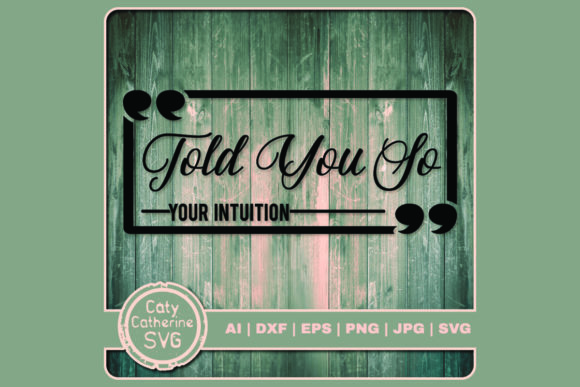
Told You So Your Intuition Funny Quote
As a designer who spends more time than I care to admit staring at stitch charts and fabric swatches, I have learned that the success of an embroidery project rarely comes down to the complexity of the file. It comes down to the concept, the clarity of the message, and how well the design translates from a digital vector into tangible thread. Today, I am evaluating Told You so Your Intuition Funny Quote, a graphic asset designed by Caty Catherine. This is not just about whether the lines are clean; it is about whether this design holds up under the tension of an embroidery hoop and resonates with a customer scrolling through their phone on a Sunday evening.
The First Impression: Mood and Visual Personality
When you first load a new embroidery file, your eye immediately scans for hierarchy. Does the text pop? Is the layout balanced? The phrase "Told You So" carries a specific energy—it is playful, slightly sassy, and deeply relatable. In the world of handmade products, relatability is currency. This design taps into that universal feeling of being right when everyone else doubted you. It creates a mood that is confident without being aggressive. It feels like something you would wear to a brunch where you want to look chic but also want to make a quiet joke about last week’s weather forecast or fashion advice.
Visually, the design relies on strong typography. For an experienced reviewer, this raises immediate questions about legibility. Text-based designs are the most unforgiving in machine embroidery because there is no texture to hide behind. If the spacing (kerning) is off, or if the font weight is too thin, the result will be muddy. Based on the preview assets provided in the SVG and PNG formats, the letterforms appear bold and distinct. This suggests high potential for a crisp finish, which is critical for maintaining brand consistency in any small business inventory.
Real-World Application: Where This Design Shines
I recently considered using this concept for a custom order involving embroidered tote bags for a local boutique. Tote bags are a staple in the craft business ecosystem, but they present unique challenges. The canvas fabric can be thick, and the surface area is often large enough that a design can get lost if it isn’t scaled correctly. However, for a tote bag design, this quote works exceptionally well. It turns a simple utility item into a statement piece. When a customer walks into a coffee shop carrying a bag that says "Told You So," it invites conversation. That is the kind of engagement that drives word-of-mouth marketing for Etsy sellers and small shop product creators.
Beyond totes, I see this design thriving in the realm of custom apparel. Specifically, sweatshirts and hoodies. The cozy, casual nature of knit fabrics pairs perfectly with the humorous tone of the quote. Imagine a cropped hoodie in heather grey with the design centered on the chest. The contrast between the soft fabric and the structured embroidery adds value to the finished product. It elevates a basic garment into a personalized gift that feels thoughtful and trendy.
Another unexpected but strong use case is baby items. There is a growing market for "sassy" baby gear. A onesie or a burp cloth with this quote, perhaps paired with a small, complementary graphic like a rolling eye or a tiny smirk, could be a hit at craft fairs. It appeals to millennial and Gen Z parents who appreciate humor in parenting. This expands the reach of the design beyond just apparel into the personalized gift sector, increasing its utility as a design asset.
Technical Considerations and Stitch Clarity
While the concept is strong, the execution depends entirely on the technical setup. Before committing to a full production run, any professional must test the design on scrap fabric. This is non-negotiable. You need to evaluate the stitch density. If the text is filled with dense satin stitches, it might pucker on lighter fabrics. If it uses a running stitch outline only, it might look sparse on a dark background.
Thread color selection is equally vital. On a white or light-colored fabric, a black or navy thread will provide maximum readability. On darker garments, you will need a metallic or bright contrasting thread to ensure the letters don’t disappear. I recommend testing the design in black and white mockups first. This strips away the distraction of color and allows you to focus purely on shape and balance. If the design doesn’t read clearly in grayscale, it likely won’t work well in color either.
Also, consider the hoop size. Ensure that the bounding box of the design fits comfortably within your standard hoops. If the design is wide, you may need a larger hoop or a multi-hooping strategy, which increases production time and the risk of registration errors. Always check the dimensions before purchasing or downloading.
Fabric and Stabilizer Choices
The choice of fabric can make or break this project. Avoid highly textured fabrics like heavy tweed or loose-weave burlap for the initial tests. These surfaces can distort the delicate details of the lettering. Instead, stick to stable knits for apparel or tightly woven cottons for accessories. Use a proper stabilizer—cut-away for stretchy fabrics like jersey, and tear-away for wovens. Skipping the right stabilizer is the fastest way to end up with a warped, unprofessional-looking embroidery project.
Where to Be Careful
There are certain scenarios where this design should be used with caution. Small hoop sizes are risky for text-heavy designs. If you try to fit a long quote into a 4x4 inch hoop, the letters will become tiny and difficult to stitch cleanly. Tiny lettering requires high-end machines and skilled digitizing to avoid thread breaks and clumping. Similarly, curved surfaces like baseball caps require careful balancing. The tension needs to be adjusted to accommodate the curve, or the text will twist awkwardly.
Additionally, be mindful of washability. If this is intended for a kitchen towel or a frequently washed apron, ensure the thread quality is high. Polyester embroidery thread is generally preferred over rayon for items that will undergo frequent laundering, as it holds up better to heat and detergent. This attention to detail builds customer trust and reduces returns due to fading or fraying.
Final Verdict for Creators and Sellers
Told You so Your Intuition Funny Quote is a versatile, emotionally resonant design that offers excellent potential for both personal projects and commercial ventures. Its strength lies in its simplicity and relatability. It does not rely on complex imagery to convey its message; it lets the words do the work. For digital product sellers, offering this in multiple formats (SVG, EPS, DXF, etc.) adds significant value, allowing customers to use it for both embroidery and vinyl cutting.
However, remember that a good file is only half the battle. The other half is your judgment as a maker. Test thoroughly. Choose your materials wisely. And always present your handmade product with pride. When done right, this design has the power to turn a simple stitch into a memorable moment for the wearer. It is a smart addition to any graphics library focused on crafts and lifestyle content.